
Shuntline›Blog›Reverse ETL · emailing
Reverse ETL from Snowflake: send the audience, not the database
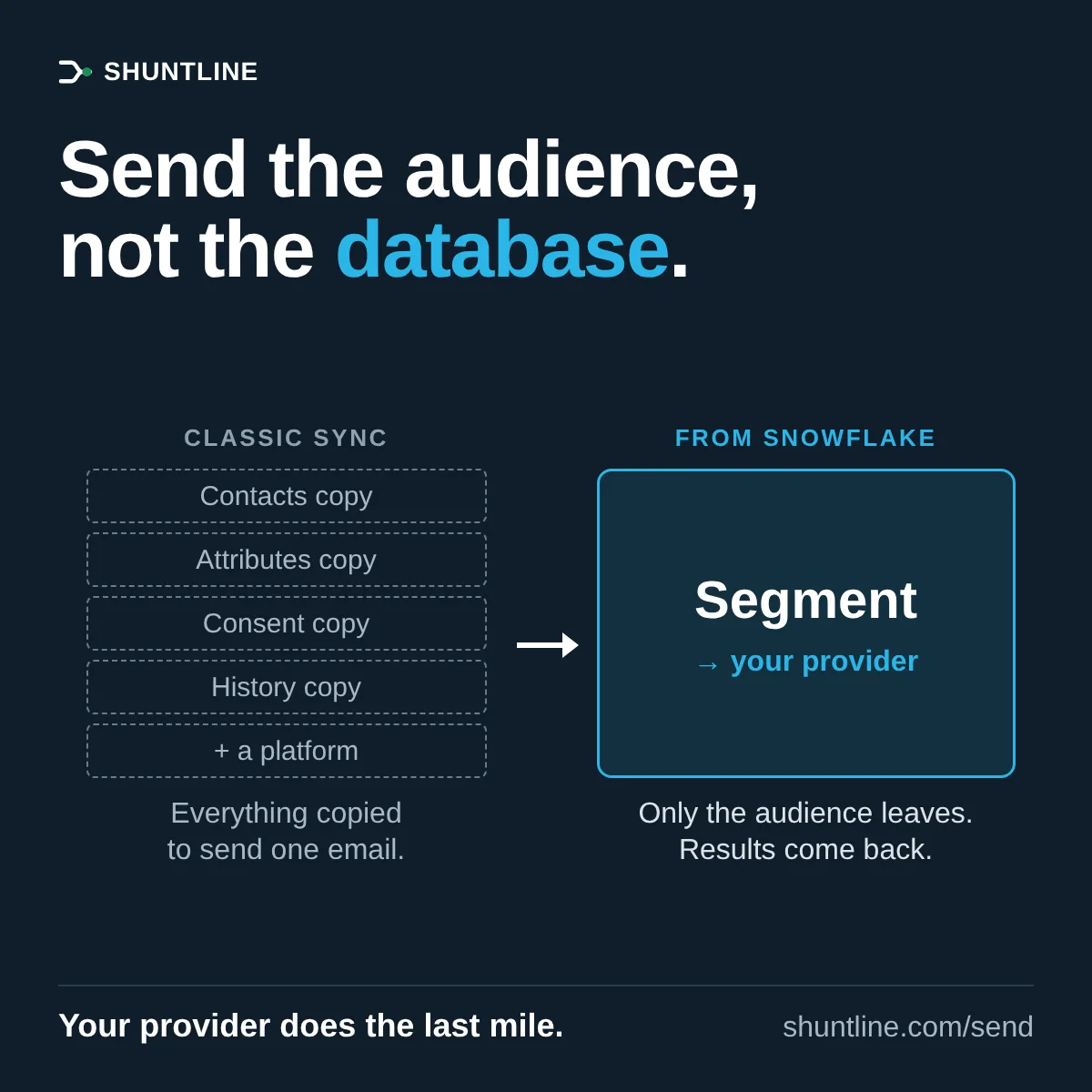
To send an email, most companies first copy their customers into a marketing platform: contacts, attributes, consent, purchase history. The copy is synchronised every night, and it is never quite right. The data was already complete, in the warehouse.
What reverse ETL changed, and what it left
Reverse ETL made the warehouse the place where audiences are built. That was a real step. But the usual pattern still syncs large tables into a downstream platform, which keeps its own copy, its own contact model and often its own price per contact.
For a large part of messaging, such as welcome emails, renewal notices, service messages, partner updates and newsletters, a lighter pattern is enough.
Three steps inside Snowflake
- Constrain. Point at a table or view you already have: customers, partners, employees. Map consent, suppression lists and campaigns as live references. Nothing is copied.
- Segment. Describe who should receive the message as conditions on your own columns. The segment is evaluated at each run, on the data as it is at that moment.
- Send. Each message is rendered and handed to your own provider account. Every message, every run and every provider answer is kept in Snowflake, where you can query it.
Consent is read, not copied
The most common fault in emailing is a stale consent flag in a copy. When the send runs where the consent register lives, the decision is read at the moment of sending. A refusal recorded this morning holds this afternoon.
The last mile belongs to a provider
Deliverability is a profession: sending domains, reputation, bounce handling. It belongs to providers such as Postmark or Amazon SES, and to Twilio, SendGrid or Salesforce Marketing Cloud for other channels and journeys. The warehouse decides who and when. The provider delivers.
Feedback goes back to its owner
Bounces, complaints and unsubscriptions come back from the provider. They belong to the systems that own them: a bounce to the contact source, an unsubscription to the consent register. The sending tool should pass them on, not keep a private suppression list.
When a marketing platform is still the right tool
Multi-step journeys, real-time personalisation across channels, creative studios, large campaign teams: that is what CDPs and marketing clouds are built for, and they stay. The lighter pattern covers the messages that never needed all of that.
In practice
Shuntline Send is a Snowflake Native App that works this way: segments on your tables, your own provider for delivery, results as SQL views. It is available from the Snowflake Marketplace.