
Shuntline›Solutions›Opt-in
Opt-in · consent register · runs in your Snowflake account
It records. You decide.
opt-in /ˌɒptˈɪn/ · noun One question, about one person, at one moment: what have they decided about this purpose, on this channel?
Opt-in is a consent register for the whole group. It holds who has decided what, the exact wording each decision was made under, and a journal of every decision ever recorded, in order, never edited. It gives each person a privacy centre, a public page served from Snowpark Container Services inside the app, through a link you protect however you like. It sends nothing, owns no customer, and lives in Snowflake, where every audience query can read it.
The problem
Consent scattered as a checkbox, nowhere as a record
In most groups, "may we email this person" is answered by a checkbox copied between the CRM, the marketing platform and a dozen forms, each with its own idea of what was agreed. The one place that needs the answer for every brand and channel at once is the warehouse, where audiences are built. Opt-in puts the register there.
One answer, many copies
Each platform keeps its own opt-in flag. None of them can say under which wording, on which channel, or whether a later refusal overrides an earlier yes.
- checkboxes per form and per tool
- sync jobs that overwrite history
- nobody holds the wording
The marketing platform as system of record
Syncing every profile to Marketing Cloud so it can hold consent makes the sending tool the legal record, and every contact a billable one.
- all profiles, not just the audience
- consent logic in segment filters
- erasure spread across tools
A flag with no journal
When a person asks what they agreed to and when, a boolean has no answer. A journal does.
- no wording version per decision
- no author, no method, no evidence
- a correction that overwrites the past
With Shuntline
How an answer is worked out
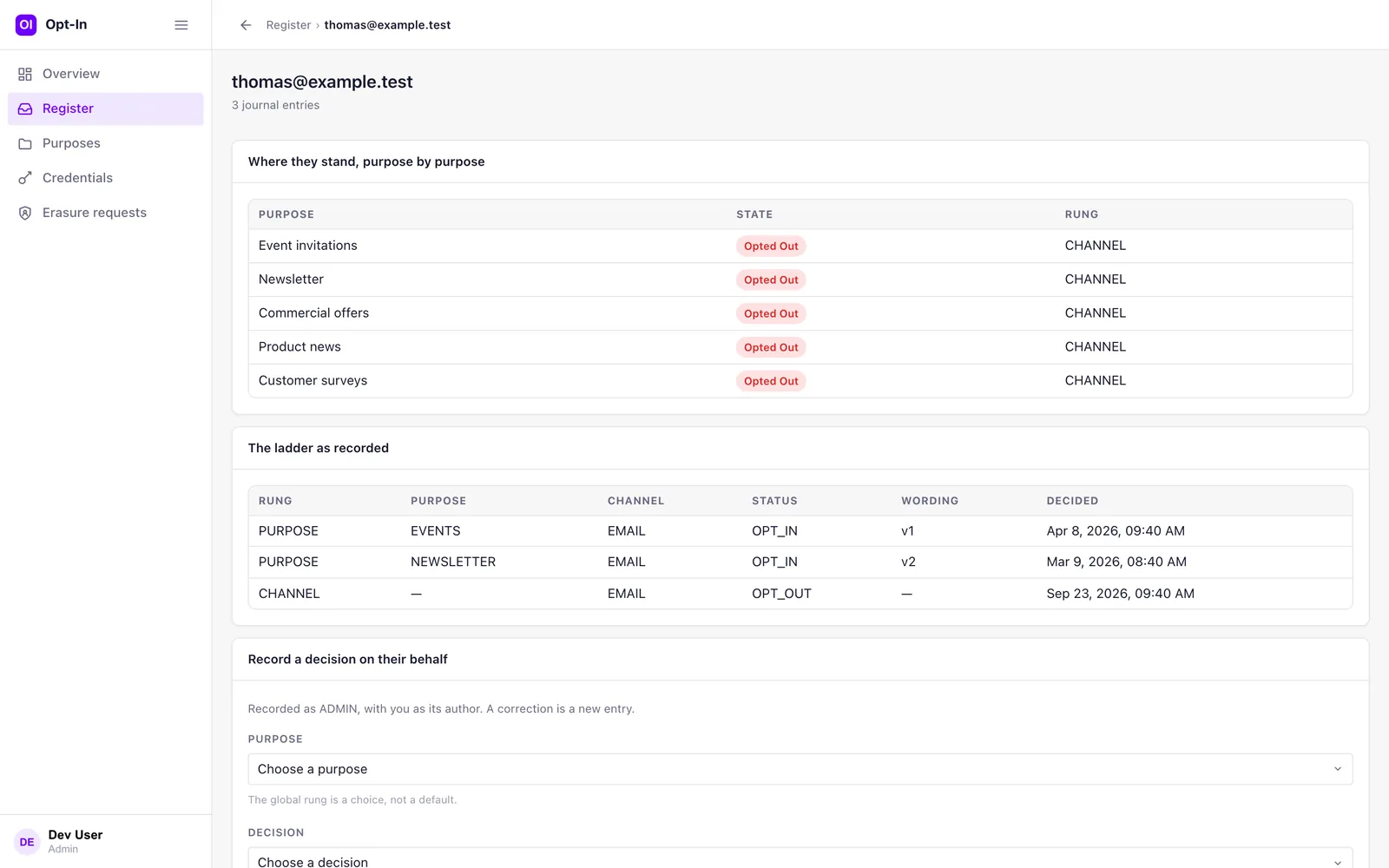
Three rungs, evaluated in a fixed order. A refusal at any rung wins absolutely and is never overridden by a more general agreement. Otherwise the most specific rung that says yes wins. A failure is never passed off as a decision.
"Do not contact me at all." One decision that closes every purpose on every channel, and stays closed until the person says otherwise.
"Not by email." A refusal on a channel beats any purpose-level yes on that channel.
"Yes to the newsletter, by email." The specific agreement, recorded against the wording in force at that moment.
What the service does not answer is whether you may act on it. That depends on your jurisdiction, your relationship with the person and the grounds you intend to rely on, and the service holds none of the three. It reports what was said; your platforms and your counsel decide what follows.
Three things it holds, and nothing else
A person arrives only when one of your systems records a decision about them. Nothing in the console creates a person, and neither does the privacy centre. The register holds an address and a history, never a profile.
Who has decided what
Per person, per purpose: the state and the rung that decided it. The ladder as recorded underneath, row by row. An administrator can record a decision on somebody's behalf, with the method and the author kept.
Purposes and their wordings
Each purpose has versioned wordings. A published wording is frozen forever and every decision cites the version it was made under. Publishing version 2 changes what the next person agrees to; it reaches back into nothing.
Every decision, in order
Append-only. A change of mind is a new entry; a correction is a new entry. There is no edit and no delete anywhere in the service. Method, author, IP and browser are kept as evidence.
A page per person
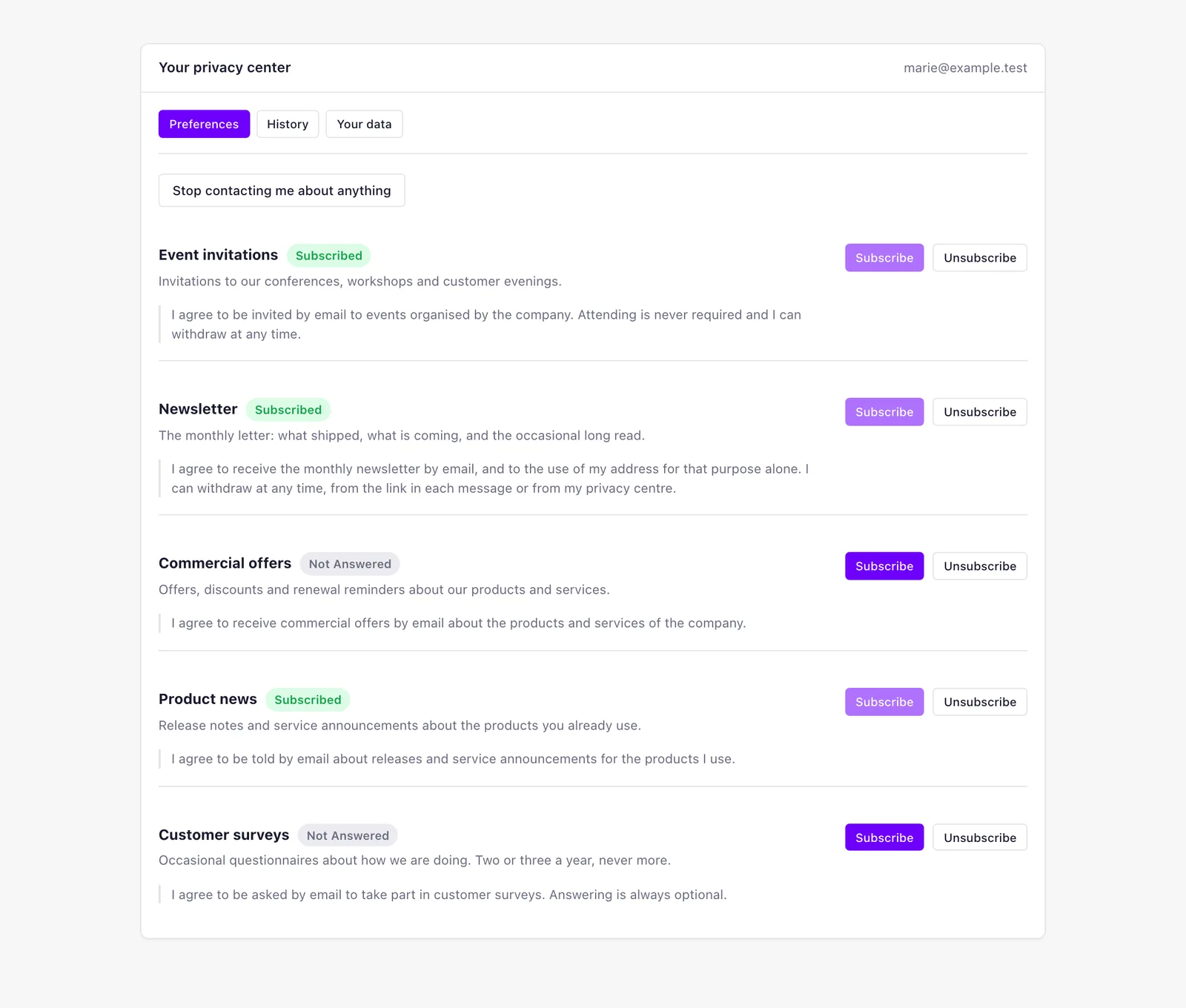
Preferences, history with the wording at the time, and a download of their data. The public page is a custom extension running on Snowpark Container Services inside the app, in your account. Reached by a link your system mints and verifies; the service never implements the checking, by design.
In by API, out by signed events
Your systems record decisions and ask what somebody decided with machine credentials. What leaves is an announcement, written with the consent and delivered minutes later: never an email address, always signed and timestamped, with a stable key so a consumer can deduplicate.
Record a decision
A form, a call-centre tool or an agent records what a person said, against a purpose and a channel. Same write path as the console and the privacy centre.
Ask
What has this person decided about this purpose, on this channel? Plus whether the purpose is still on offer and has a published wording.
Mint a privacy-centre link
Your system asks for a link for one person, verifies them however you choose, then tells the service the check passed. Seven days by default, revocable at once.
Five announcements
Opted in, opted out, global opt-out, recorded, and erasure requested. Identifiers and codes only, signed, retried with a widening interval. One destination, set by the operator.
Consent as a table
In Snowflake, the register is a dataset every audience query, dashboard and agent can read with your row access policies. No sync needed.
Consent in the join, not in the sync
The strongest reason to keep the register in Snowflake: audiences are built there. An audience query joins CRM context, campaign attribution and consent in one statement, and reverse ETL pushes only that segment to the platform that sends. Every profile no longer has to live in Marketing Cloud for it to know who may be emailed.
Built to be audited
Everything the register says can be shown, with its evidence, to the person it concerns and to whoever reviews you.
Carried out, and said plainly
An erasure replaces the address with a token that leads nowhere and derives from nothing; the journal stays. Where free text supplied by a client system cannot be erased, the tool reports it and calls the erasure incomplete.
Horizons you configure
No automatic erasure unless a retention horizon is set. Bulk erasure of everybody dormant past a horizon is a command, run on purpose.
A bearer credential, bounded
Thirty-two bytes of randomness, no public page accepts an address, seven-day default lifetime, revocable immediately, carried in the URL fragment so it never reaches a web-server log.
Nothing pre-ticked
The privacy centre offers Subscribe and Unsubscribe per purpose, and one "stop contacting me about anything". There is no "subscribe to everything": bundled consent is refused by design.
Issued once, revoked never deleted
Machine credentials are shown once and stored as a hash. Revoking stops them immediately and keeps their call count and last use.
No compliance claim
Nothing here claims compliance with any regulation. What is implemented are technical controls: a frozen wording per decision, an append-only journal, exhaustive erasure and evidence per entry. What they are worth under your law is yours to assess.
What it will not do
A short list of boundaries keeps the register simple to trust.
Send anything
No email, no SMS, no push. It records, reports and announces what changed; something else sends.
Decide for you
No jurisdiction table, no "mailable" count. It reports what was said; you decide what follows.
Verify a person
No one-time code is built in. Your system checks who holds the link; the service only honours, expires and revokes it.
Goes further with
Opt-in stands alone. Joined to leads and campaigns in the warehouse, consent becomes a column in every audience.
Questions about Opt-in
Short answers to what architects, CRM owners and marketing ops ask first. Everything here is also in the pages above, in more depth.
What is Shuntline Opt-in?
A consent register and a privacy centre per person, running in your Snowflake account. It records what each person decided, per purpose and per channel, with the wording they saw, the version of it and when. Your platforms act on the record; the register does not send anything.
How is consent modelled?
Three rungs (purpose, channel, wording), four states per decision, versioned wordings and an append-only journal. A change of wording creates a new version; earlier decisions keep pointing at the text the person actually saw.
Where does opt-in fit in a reverse ETL strategy?
Consent lives in the warehouse as a dataset, so an audience is filtered by the consent its purpose needs before any profile is pushed to Marketing Cloud or other downstream solutions. The right audience, with accurate data, rather than syncing every profile.
Does it replace a consent management platform on the website?
No. Banners and forms keep collecting choices; Opt-in is the system of record behind them, where every decision from every channel lands and can be proven.
Walk a consent through the register
Bring a real purpose, its wording and a few decisions. We record them live, show how the ladder answers, mint a privacy-centre link, and build an audience query on top.
- A working session with the team that builds it
- Your purposes and wordings, your decisions, the answer each returns
- Snowflake architecture, security and hosting questions answered